
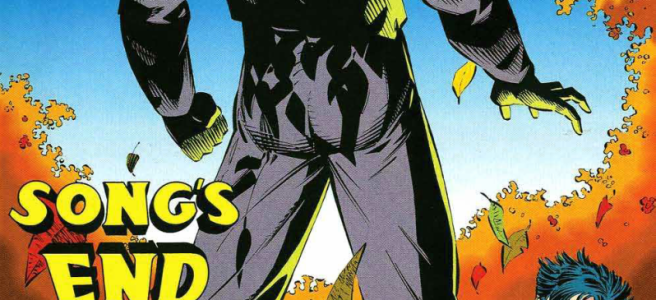

Credits: Written by Scott Lobdell, pencilled by Brandon Peterson, inked by Dan Panosian and edited by Bob Harras
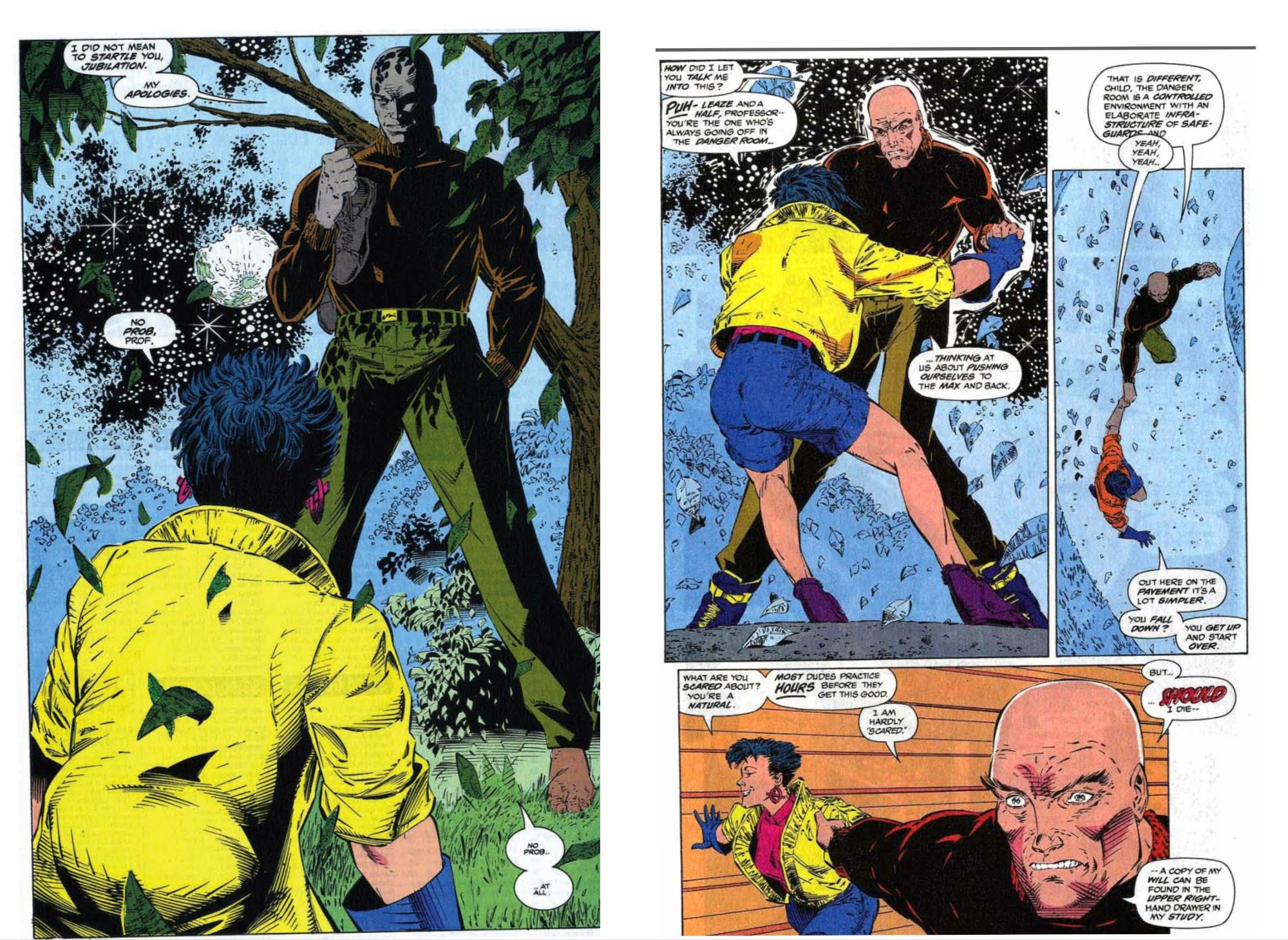
Plot: “Up and around” is a 3 story plot set in the immediate aftermath of the battle on the moon that cost the lives of Cable and Stryfe. The smaller story stars Rogue, who after being injuring battling the MLF is feeling more vulnerable than usual and frustrated at her inability to touch anyone tries to keep Gambit at arm’s length. Gambit doesn’t listen and the two spend the night, just being with each other. It is neither a new thing, nor an interesting thing, so lets look at the other two. Story one if Jubilation Lee and Charles Xavier bonding. Until the last of the techno-organic virus leaves his system (in about 24 hours after he was saved by Apocalypse) Charles has a working spine and can for the first time since the formation of the Blue & Gold teams can walk. Jubilee, wandering around the grounds finds him walking barefoot in the grass and finally able to see him as a person, rather than the parental/mentor figure that she’s seen him as. The two go roller blading and both end up in a nearby lake. As the sun starts to rise, the 24 hours is up and Charles has to crawl back to the wheelchair he is once more trapped in.
The other end of the tale is Dr Henry ‘the Beast’ McCoy and Warren Kenneth ‘Archangel’ Worthington III fly into Salem Centre to fix up Harry’s Hideaway Pub, which was trashed by Caliban when he kidnapped Scott Summers and Jean Grey back in part one. They do this secretly under cover of night and reminisce about their shared histories. They fix up the bar, but are discovered by a local police officer, but they use image inducers to avoid undue problems before returning home, safe in the knowledge they’ve done good work.

Notes: As important as the big climactic events in X-Men are, I cherish just as much these smaller aftermath stories. Scott Lobdell was particularly good at them, mixing humour and pathos and allowing characters to grow in the shadow of these great events. This was one of those. The Rogue story is paper thin, playing the whole ‘I can’t touch you’ refrain and it’s more of that. The Beast and Archangel story works better by letting you see the consequences of the battles that involve the X-Men. The only problem I have with it, is it perpetuates that whole ‘Marvel scientists are experts at everything.’ trope that can get on your nerves. Beast can rewire alien tech? Work on viruses of all kinds, serve as medical doctor for the X-teams as well as re-build a pub? His training, if memory serves, is in genetics. Still, I did enjoy this two old friends that you don’t see in many scenes together reminiscing. But the strongest story is Jubliee and Professor X, finally bonding. From issues Uncanny X-Men 1-200 Charles Xavier was the heart of the X-Men. He was always there and became part of the furniture. From issue 201-274 he was gone and in that period Gambit and Jubliee had joined, so Jubliee made her bones without having anything to do with the professor and honestly there’s not many moments between them. This was the first time that she saw that he was an actual person, one who mourned the loss of his ability to walk. It was a story about how the people in positions of authority are often still just people. By the end, all she wanted was for him to be able to take those last ten steps alone, but he couldn’t, so she helped him. Two people helping one another, a bigger exemplar of Xavier’s dream you couldn’t find. This was a story that wasn’t about high stakes and epic battle, but the moments after that and how we find one another.
Verdict: Writing 4 out of 5 – It only loses a point for the rather pointless Rogue scenes, but other than that Lobdell does the job well. He makes us buy the bonding between the founder and youngest member of the X-Men. We also get a sense for the first time that Hank and Warren are old school friends and we see an OG X-Men pairing we don’t usually get to and I was here for that.
Art: 3 out of 5 – Peterson is okay, nothing special, but keeps you in the moments he needs to, his work is consistent and you follow along well. The inks are perfunctory and the colours aren’t anything to write home about, but the issue works well in how it needs to.
Overall: 7 out of 10 – One of the several solid aftermath issues of this era, it never feels that it’s a boring comic or that you want some kind of action and for a genre that makes its living on melodrama and violent action, that’s a hell of a feat.
Next Time: No more Ben Reilly as the Scarlet Spider, but that’s not the end of the Scarlet Spider.
 My Marvel Life